

For over a decade, the desktop 3D printing industry moved at a steady, incremental pace. Enthusiasts and hobbyists accepted a certain “tinkerer’s tax” the unspoken agreement that to achieve a high-quality print, one had to endure hours of meticulous bed leveling, agonizingly slow print speeds, and the constant threat of mechanical failure. 3D printing was as much about maintaining the machine as it was about creating the object. Then came Bambu Lab.
Emerging from a core team of ex-DJI engineers, Bambu Lab didn’t just enter the market; they shattered the ceiling of what a consumer-grade 3D printer could achieve. By applying drone-grade stabilization technology, sophisticated artificial intelligence, and a holistic “ecosystem” approach, Bambu Lab has turned a complex, often frustrating hobby into a streamlined, high-speed industrial revolution for the home.
The Speed Revolution: Breaking the 500mm/s Barrier

Before the arrival of Bambu Lab’s flagship X1 Series, “fast” printing usually meant sacrificing surface quality and structural integrity. Most consumer printers chugged along at 50mm/s to 80mm/s. Bambu Lab redefined the industry standard by achieving sustained print speeds of up to 500mm/s and accelerations of 20,000mm/s².
How did they achieve this without the printer shaking itself apart? The secret lies in Active Vibration Compensation. Using drone-derived algorithms and internal accelerometers, the printer measures the resonance of its own high-speed movements and counteracts them in real-time. This eliminates “ghosting” or “ringing” those faint ripples on the surface of a print resulting in buttery-smooth finishes even at breakneck velocities. For the user, this means that a project that once took 20 hours to print can now be completed in five, fundamentally changing the workflow of rapid prototyping.
The AMS: A Multicolored Masterpiece
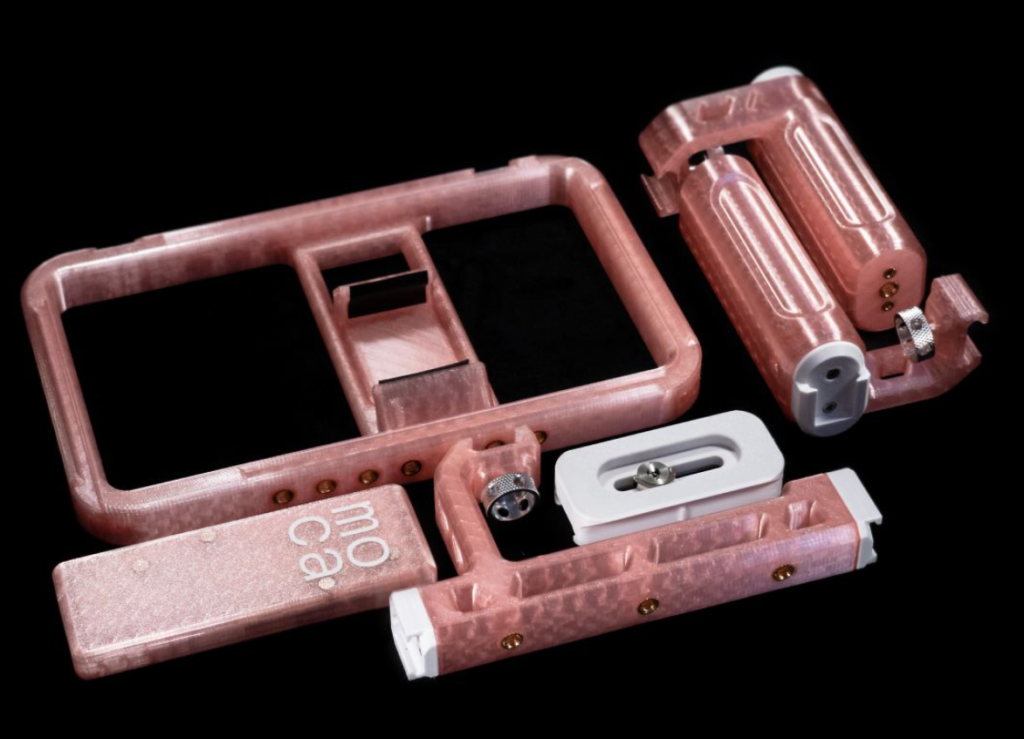
Perhaps Bambu Lab’s most iconic contribution to the industry is the Automatic Material System (AMS). Historically, multi-color 3D printing was a clunky, expensive process involving multiple extruders or complex manual filament swaps that often led to failed prints.
The AMS is an airtight, intelligent unit that sits atop or alongside the printer, holding up to four different spools of filament. The printer’s firmware communicates with the AMS to automatically switch between colors and materials, handling the “flush” and “purge” cycles seamlessly. If four colors aren’t enough, users can daisy-chain up to four AMS units to access a palette of 16 different colors or materials.
This innovation has opened a new world for creators. It allows for high-detail figurines with painted-on textures, functional parts that use breakaway support material for a perfect finish, and professional-grade prototypes that look like finished retail products right off the build plate. It transformed multi-color printing from a technical nightmare into a one-click reality.
AI at the Helm: The Micro-Lidar and Computer Vision

Bambu Lab printers are among the first in the consumer space to utilize AI-driven inspection to ensure success. The X1-Carbon, the brand’s high-end powerhouse, features a micro-lidar sensor and an onboard neural network that acts as a tireless quality control officer.
One of the most praised features is Spaghetti Detection. Using the onboard camera, the AI can recognize when a print has lost its grip on the build plate and turned into a tangled mess of plastic “spaghetti.” Rather than wasting half a spool of filament while the user is away, the printer automatically pauses and sends a notification to the Bambu Handy app on the user’s smartphone.
Furthermore, the lidar sensor scans the “first layer” of every print. In 3D printing, the first layer is the foundation; if it isn’t perfect, the entire print is doomed. Bambu Lab’s AI inspects the extrusion height and flow, making micro-adjustments on the fly to ensure a perfect “squish” every single time. This level of automation has effectively eliminated the need for manual bed leveling a task that used to be the bane of every 3D printing enthusiast’s existence.
Software and Community: The Bambu Ecosystem

Bambu Lab understood early on that hardware is only as good as the software that drives it. They developed Bambu Studio, a proprietary slicing software based on the open-source PrusaSlicer but heavily modified to leverage the specific hardware capabilities of Bambu machines.
To complete the circle, they launched MakerWorld. Unlike other 3D model repositories, MakerWorld is deeply integrated with the Bambu ecosystem. Users can find a model, see exactly how much filament it will use and how long it will take on their specific printer, and then hit “Print” directly from their mobile device. This “one-click” experience has lowered the barrier to entry for millions of people who were previously intimidated by the technical hurdles of 3D modeling and slicing.
A Printer for Every User Level

Bambu Lab hasn’t just catered to the high-end market; they have democratized their technology across several price points:
- X1-Series: The “Gold Standard” for engineers and power users. With its 300°C nozzle and enclosed chamber, it is designed to print advanced materials like Carbon Fiber-reinforced Nylon and Polycarbonate.
- P1-Series (P1P & P1S): These models retain the incredible speed and AMS compatibility of the X1 but strip away some of the premium AI features and sensors to offer a more affordable price point for serious hobbyists.
- A1-Series (A1 & A1 mini): The latest revolution in entry-level printing. Despite being budget-friendly “bed slingers,” the A1 series features full-auto calibration and multi-color capabilities via the AMS Lite, making them the perfect gift for students or beginners.
The End of the Tinkering Era

Bambu Lab has effectively removed the “barrier of frustration” that kept 3D printing from becoming a mainstream household tool. By automating the most difficult parts of the process calibration, leveling, material management, and failure detection they have allowed creators to stop focusing on the machine and start focusing on the design.
Bambu Lab stands not just as a manufacturer, but as a benchmark for the entire industry. They have proven that 3D printing can be fast, reliable, and colorful without requiring a degree in mechanical engineering. As we look toward the future of localized manufacturing, Bambu Lab is the engine driving us there, one perfectly layered print at a time.


